Monday, January 29, 2018

The Modern Quilt...improvised....


I love Improv!! That doesn't mean that some Planning doesn't go into it...I think all the best improv starts  a well thought out structure  and then you get to feeling improvise on top of that...whether it's comedy, or music or  quilts...


As I look back over the quilts I've made - and there are quite a few! coming up to around 300 now...it's the simpler ones that I actually like the best....and they are so much more modern!


When I look at other people's work...and when I advise and suggest in my various classes I'm always urging for an elegant economy.  If you look at some of Picasso's early drawings and Matisse...with just the fewest of lines they create a whole world of impressions.


.....and of course some nice bold hand stitching is just the cream on the cake!  something that we as quilters and fiber artists can do that isn't possible with mere pigment!


and so I had a lot of pleasure writing the Mod Meets Improv class for the academyofquilting  coming up with different starting points for beautiful elegant quilts that are surprisingly easy to make.


I have a new class starting the end of this week, if you're interested.  The classed that the academy runs are very inexpensive...I just took two expensive painting classes, and honestly the class was huge and the students got Very Little feedback...and none of it with helpful suggestions for overcoming problems.  


 I really like to help people move forward in my classes and I think showing people how to analyze problems and then find possible solutions is what a teacher is there for.  I have been very critical of many classes I've taken because the teachers don't do that - usually they're just too nice, but often they have too many people and so simply iterate the original instructions...just too much effort to go beyond that.   it's actually worse in painting than it is in fiber arts!  but, it occurs everywhere...


.of course private lessons are really really nice!!!  as I'm discovering in several of my endeavors....but they are expensive and I think a small group lesson is a good starting point.


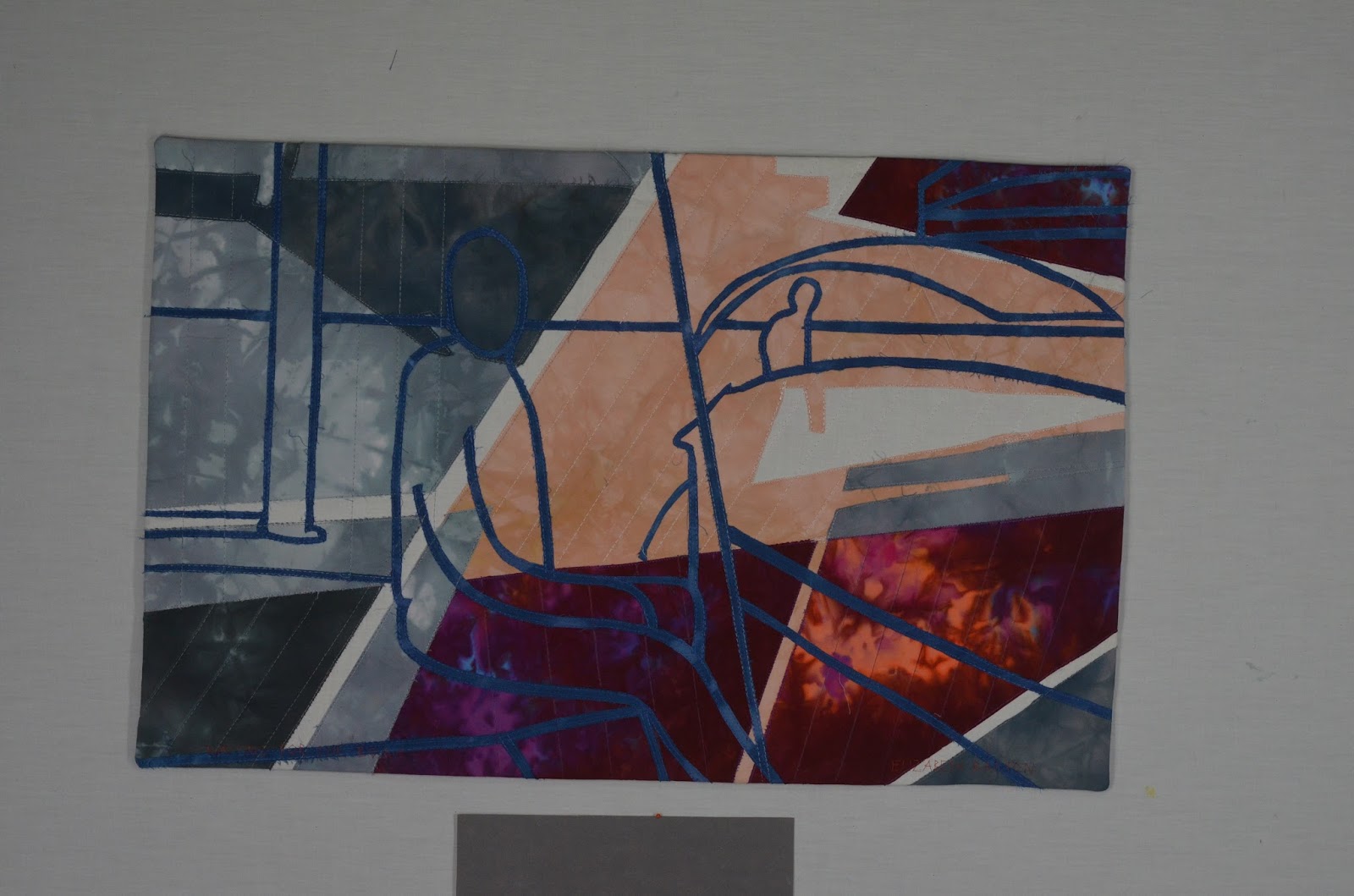
These are quilts I've made over the years that were not complicated, one is traveling with SAQA in a Mod Quilt show....others still reside here, some I've sold, some I've traded!!  Love a good trade.


so if you're looking for a new, fresh approach to quilting.....consider taking the Mod meets Improv class!!
I have an even easier class coming up mid February..but it's a lot of fun: it's basically a reality show!  More about that when I have a firm date for its running.....


Meanwhile, I hope you've enjoyed looking at these quilts!!! I love to meet you in class!
If  you have been, thanks for reading!!!  Elizabeth


Wednesday, January 3, 2018

Journey into Abstraction!


A lot of people feel that they don't understand abstract art...and as a result don't like it.
Even one of my close friends came up with the line "my 5 year old could have made that" - nearly as bad as "not your grandmothers' quilts" right???
Not your grandmother's phone, or her clothes or her tv or her car or probably her diet for that matter!!!

Good abstract art could not be made by a five year (unless perhaps Picasso as a child, as Mozart composed when he was a tot) - they simply don't have the sense of organization, the ability to judge between what adds and what detracts, the sense of color, how to convey mood etc etc.

I do think though, that if you want to make abstract art it's very helpful to have some idea of the processes, particularly the design processes that the successful abstract artists have used.
and this is what my class: More Abstract Art for Quiltmakers, starting Friday with www.academyofquilting.com
attempts to do.


 The class examines some of the more influential abstract painters since abstract art began - yes! with a woman painter!!  Hilda af Klint.    Not poor old Kandinsky as he claimed.  Women were there FIRST.....    From each "school" of abstract art, I derived design exercises that  you can use to create many many designs of your own.


Some you will like, others you won't...but you will have a lot more knowledge of abstract art as a whole...and a number of very straight forward starting points to set you on your own journey to abstraction.


This class is parallel to my Abstract Art for Quiltmakers class. They deal with the subject in different ways. More Abstract Art looks at the history and the popular abstract painters we know. Abstract Art for Quiltmakers focuses particularly on the contributions made by female abstract artists.
all the exercises are different, if you liked Abstract Art for QM, you'll like More Abstract Art for QM - but you'll have many different things to try.

Happy to answer any questions!
If you have been, thanks for reading!  Elizabeth

Wednesday, December 27, 2017

Learning Till the End of Time

It just dawned on me.....

"You would like to have lessons with me till the end of time", said The Pedagogue at my last piano lesson....and so I started cogitating upon why I like taking lessons so much - especially one on one..but any lessons really - from a good teacher...not one of those frustrating ones that tell you everything you do is wonderful - I'm sure we've all been in workshops like that...at first it feels good, then you think "I'm not getting anything out of this!"

I think the main reason I love lessons is  because I really enjoy learning new things, or - even more -  learning how to do/make those things I already do, better and stronger. I love learning more about art, and music, and more about learning itself.  I'm particularly interested in finding out the best ways to learn. Robert Bjork is very interesting on this - lots of You Tube.
And, yes, there's the 10,000 hours idea...but this number has been challenged on many levels.
If you haven't heard of it, a popular science writer summarized a number of findings on learning - (particularly with respect to music) and concluded that 10,000 hours of practice would make you an  expert.

However, many researchers dispute this e.g. * Macnamara et al (2014) examined all the relevant research and concluded:

" deliberate practice explained 26% of the variance in performance for games, 21% for music, 18% for sports, 4% for education, and less than 1% for professions. We conclude that deliberate practice is important, but not as important as has been argued."

The original research was carried out by Ericsson, Krampe and Tesch-Römer in 1993 on violin students in Berlin. They noted that the best students had practiced around 10,000 hours by the time they were 20.  However to conclude from that research (as has been done)  that 10,000 hours is both a necessary and  a sufficient amount of time to become an expert is invalid. 


In 2017, Ericsson and Pool wrote a book about the limitations to the 10,000 hours idea **. (by the way there are a lot of negative reviews of this book too!).  One of the big problems with the 10g hours theory is that the variation of the number of hours the students had practiced was great, some of the better ones had done less than 10g, some more...10 g was only the average. And, there are other studies suggest that it takes 10 years  rather than 10k hours...to achieve a good level of mastery of whatever craft/acitivity you wish to learn.

And what does "practice" actually mean?  Making or doing the same old same old just doesn't cut it.  Everyone does agree that you need to push yourself further, take risks, make the tasks progressively harder, get lots of feedback about mistakes or weaknesses and then devise specific strategies to work on those.  As the athletes do.
People who are very honest with themselves about their work, and who gain good feedback - even if difficult to hear - (and believe me I've been through that!) -  do improve faster than those that keep repeating the same stuff.  Often it's when you hit that brick wall and struggle and struggle and really think about what you have to do to overcome it that you make the most progress.

The research on so-called brain games also suggests that it's not just using our brains that makes the differences, it's taking on ever more difficult tasks.  So, if you want to get anywhere, it's probably not going to be easy.   But then...you are in good company!  If you learn a new brain game and then just settle into playing it over and over,  the brain begins to make things automatic. That doesn't lead to more cognitive strength.  which is why most "brain games" are completely pointless once you've got the hang of them!  That's not so say that they might not be fun!  but just don't kid yourself you're preventing Alzheimers.
On the positive side, it is very evident that the more you learn, the more you challenge your brain, the better it will work, the more creative it will be.  So really the answer is, stop reading the self help books and start challenging yourself!! Every new challenge is a step forward.
Learning is good for the brain!  It's good for you...but furthermore, it's one of the most exciting human activities there is...it's the something special that we as human being can do - to push the limits of our knowledge, of our skills and our creativity...and to keep on doing it to the very end!

 Oh, I don't think my piano teacher is going to get rid of me very soon,  for learning feels so good.

If you have been, thanks for reading! 
  I hope your New year is both healthy and FULL of learning!   Elizabeth

Ps. There's still time to enroll in the 2018 masterclass - either in the basic program of assignments, or as an independent student.  Just contact me: elizabethmasterclass  AT gmail.com

* 

Deliberate Practice and Performance in Music, Games, Sports,

 Education, and Professions

A Meta-Analysis

First Published July 1, 2014 Research Article


** Ericsson and Pool:  Peak: Secrets From the New Science of Expertise. 


Sunday, November 26, 2017

Build your own Master Class!

It's upcoming to winter here in the S.E. of the USA....that is if we have a winter at all!  Last year we had about 6 weeks...and so far I still have impatience blooming in the garden - left over from last summer.....

I'll be starting my 2018 Masterclass on January 1st.
It's a yearlong commitment to improving your quilt designs (or other fiber media for that matter, I have had weavers, stitchers and embroiderers in the class).

Each month I issue a new assignment which addresses a key design concept such as the importance of good value patterns, how to achieve the illusion of depth or motion, how to work from a photograph, how to develop good color schemes and so on.  Each assignment can be interpreted by representational or abstract work and if you veer off the assignment a little, I won't mind! (Recently I took an online course where pretty much the only feedback I got was "you didn't follow the instructions"! - very hard for an iconoclast to do that!).

My principal interest is helping you make stronger work, and in avoiding the many pitfalls there are in designing and creating art.   I'm fortunate in that I have many art friends here and we can help each other with critiques but many don't have that.   Research in improving one's performance rests on two things: the amount of time you give to it PLUS informed help along the way.   It's not just the 10,000 hours....it's the hours plus the personal help.
I think it's important to give critiques that focus on the strengths, but also address any weaknesses and suggest solutions.  I've always enjoyed problem solving and this is a great way to help others.  I used  to do a lot of traveling and teaching, but (as I'm sure you know) travel is just not much fun anymore...plus I was frustrated by not being able to follow through with the students for a significant period of time to help them move forward.  Having decided to get piano lessons after having failed to teach myself (for some time! ), I realize the huge importance of the regular contact with the teacher and mentor over a period of time.


I offer a year long Master Class with a blog and 10 assignments. I critique these at three stages: design sketches (need not be fancy!), blocking out, and finished work.
If you're at all interested please email me at elizabethmasterclass@gmail.com and I'll send you full details, feel free to ask any questions.

Also, since I have more time now as I'm not travelling very much, I would like to offer a "Build Your Own MasterClass" - write and tell me what you personally would like: suggested assignments, or self-chosen ones, frequency of assignments, amount of responses from me and I can see what I can arrange and what the cost would be. A "personalized" course!


For the year long Master Class with the Master Class blog where you can view other students' work and my comments (this is as anonymous as you wish), please email me by mid December.
The strength of this class is twofold: the timetable helps to keep you on target!  And secondly, you can learn a great deal vicariously from seeing how I respond to other students' work.

  For a Build Your Own Class - just email me any time!  Let me know what you are interested in....and I'll see what I can do.

Looking forward to hearing from you.
If you have been, thanks for reading!!   Elizabeth

NOTE: I've had several queries about more details for the Build Your Own class...
please go to the special blog    for more information!  Thank you.   Elizabeth

or write to me directly: elizabethmasterclass AT gmail    for details of my regular master class.


Saturday, November 11, 2017

What is Style?


I was just reading about the artist's style in International Artist, in which Paul Balmer describes that for the artist finding one's individual style as "probably the most difficult task"....and his discovery of the answer.

I must admit that discovering my own style or creating a style was something I never really thought about...I just made quilts the way I wanted to about what interested me at the time...but I did always work in a series.  and again that has always seemed to me to be the natural thing to do.


 You make something and really like it...so you want to make another!!!  or something similar...and in  making that second one, you think of different ways you could have done it..so then you make a third...and the third begats the 4th, the 4th begats the 5th and so on... and so on!!

So I was curious to see what this painter's great breakthrough discovery might be.     And it's very interesting and something that I have seen in some of our famous quilt artists.

He had tried several things, like all of us, gone on courses, had favorites artists that inspired him...but then he goes onto say that the real breakthrough came  when he disregarded convention and tried something completely new - a new technique.


 For him it was the application of power tools to the painting - drawing with a dremel and sanding layered painting to reveal layers beneath...neither of this would I think work well with a quilt!!! but nevertheless inspiring of cogitation!

The central truth is: disregard convention and think up with a new way of approaching the task.  As we saw Nancy Crow do back in the late '80s and early '90 when  she took the idea of cutting out her fabric shapes freehand from what she had seen of  the quilts made by Anna Williams, the Gees Bend quilters and the Oakland quilters.. all African Americans working in ways they (or their ancestors) had learned through a combination of hardship and traditional African banner making techniques. 

At that time leading quilters were Jinny Beyer and people like that who were all about precise and complicated geometrical piecing...perfect points, discreetly matched fabrics.

Jan Myers Newbury took the old traditional Japanese shibori techniques, gave them a modern loose and much more painterly approach and began her long series of beautiful quilts all based on arashi shibori. 

Linda Levin quit using dye and turned to paint...painting pieces of cloth that she then cut up and applied very roughly and to a base layer of batting  (usually flannel) and backing.  I remember her work being criticized early on by people who felt that all appliques should have neatly turned under edges, Linda didn't even pretend to cover the raw edges!!!

Paula Kovarik discovered that she loved machine quilting...literally drawing and writing with the machine needle to create complicated doodles or diaries......

Suzie "Lucky" Shie decided to write her diary and impressions of her world ..out large on fabric rather than in a small conventional diary notebook.  She used air powered pens and brushes...which hadn't been used on quilts before.

So all of these people made the leap into what became known as their particular style based on a technique, usually borrowed from outside the quilting world......

If you think about it, a lot of Painters did this too.  Jackson Pollock notieed paint drips  occurring on the floor as he painted...he liked the drips...they looked interesting, fresh and new...so he took the canvas off the wall, put it on the floor and dripped on it!!!


 Helen Frankentaler decided to forgo the idea of pretreating her canvases with gesso, and instead worked on the floor staining them with thinned paint.

Emily Richardson thinned down acrylic painted and use it to paint  on recycled silks which she then hand sewed together.

So...if you want to develop your own style and feel that you have not yet found your way... consider  looking outside the quilt world - to other art media, to the real world.  And when you have found a technique that you'd like to try, stick with it...the first few pieces will probably be more experimental samples than anything else...but keeping on going as all the above folk did will lead you..if not to the Holy Grail(!) at least to a recognisable style.  so finding a technique that you could apply in a new and different unconventional way is the answer...or one of the answers!!

Another way to a style is to work from imagery that no one has used before...photographers are well known for this ...before Bernd and Hilla Becher  no one had shown interest in the Low Graphic  style they used or in the photographing of forgotten industrial buildings - factories, pit heads and the like.


 Well, if you have been...thanks for reading!! And do let me have your comments...your own particular path to style discovery.......

Elizabeth

Sunday, October 29, 2017

THe Christmas Sales season - make me an offer!


 A friend and I have decided to sell our work at a Christmas  fair!! or rather a "Xmas fayre in a Xmas shoppe"!!!! Yes I know you're puking!!! but tis the season and all that!!! 

She suggested I  cut up some of my quilts to make them into "bite sized pieces" - which actually turned out to be quite fun!!!  It's amazing when you do that, how you can discover much better little compositions within the whole.....I didn't take any photos....she's backing them for me right now!

But I also thought I'd have a"make me an offer" section too....let's face it I have a room FULL of quilts...most of them really rather nice, they've been in  both quilt shows and  art shows ...I have no spare walls left in my house...so...why not suggest that people simply make me an offer?  Pase comment if you object...and tell me why? I'd much rather I had pieces out there being enjoyed by people, than rolled up in a room facing a doubtful future!
Of course I can always say: "well er....I've got a nice little bite sized piece here might suit your budget better!!!"

THe quilt below is for those that think everything HAS to be red and green and Christmas!
Everything you can Imagine is Real 49 x 34


Waiting for the boat 29 x 19

 How about the one above for the boat owners or rather would be boat owners in your life?

Four Rooms with a View 33 x 22
Or the one on the right for the literary types?
The First Machine 33 x 20

Above for those who like to take things to bits!!! and Below for the oil men in your family!

An
All that glitters is not gold 40 x 18

Ambivalence 35 x 48
this would  be a good quilt for those who can't make up their minds....

Athens , summer light 39 x 26
A nice one for somebody who like to trim hedges and keep them all very neat......!!!

Black and White, No Grey 38 x 53
Two black and white ones for the elegant aunts...the one above for the Political Aunt, and the one below for the musical one.....
Overture 35 x 47
Don't forget the train spotter....or factory owner.....
What Pretty Smoke36 x 43
Of course I don't know just how many would be boat owners, oilmen, train spotters, pollution inspectors and the like will be at the "fayre" but I shall have a lot of fun imagining them!!!

All comments most graciously read and replied to!!  
If you have been, thanks for reading......Elizabeth


Wednesday, October 18, 2017

A beautiful fall day here in Georgia - finally!! A day of complements.

Highlands, FAll


Fall is such an inspiring season for so many of us, all those lovely warm colors mixed together....once again nature gets it right!

it's always good to have one dominant color in a piece, one color  that sets the mood for the whole piece.  It doesn't have to be the most saturated, the most intense color...in fact it's probably better if it isn't - that would be too dominating....  but having one main color helps to pull the piece together as a whole...it creates a color structure for the piece.  

This is actually very easy to do, and is one of the basic technical "tricks" of artists.  Set the mood with color!  In the above piece I've split the usual red of autumn into orange and pink and scattered those shades, in various values, throughout the piece.  

I've added a little complementary color - green.  This is because having the complement of the color enables the eyes to refresh and so makes the first, the dominant color even richer.

Complements, of course, are simply opposites on the color wheel.
Adding a complement is another artist's tool!  if your colors are looking a bit flat, add a dash of complement!

So: a dominant color, a complement, a quick dash of something bold and intense - if needed - you might already have it...and a good helping of neutrals.....and you have a tasty color dish!

All comments and compliments! gratefully received, most desirable - I've been teaching a square dance class introducing the idea of desirable difficulties in learning!  so I'm well up on desirable!
especially when it comes to difficulties!

If you have been, thanks for reading.   Elizabeth